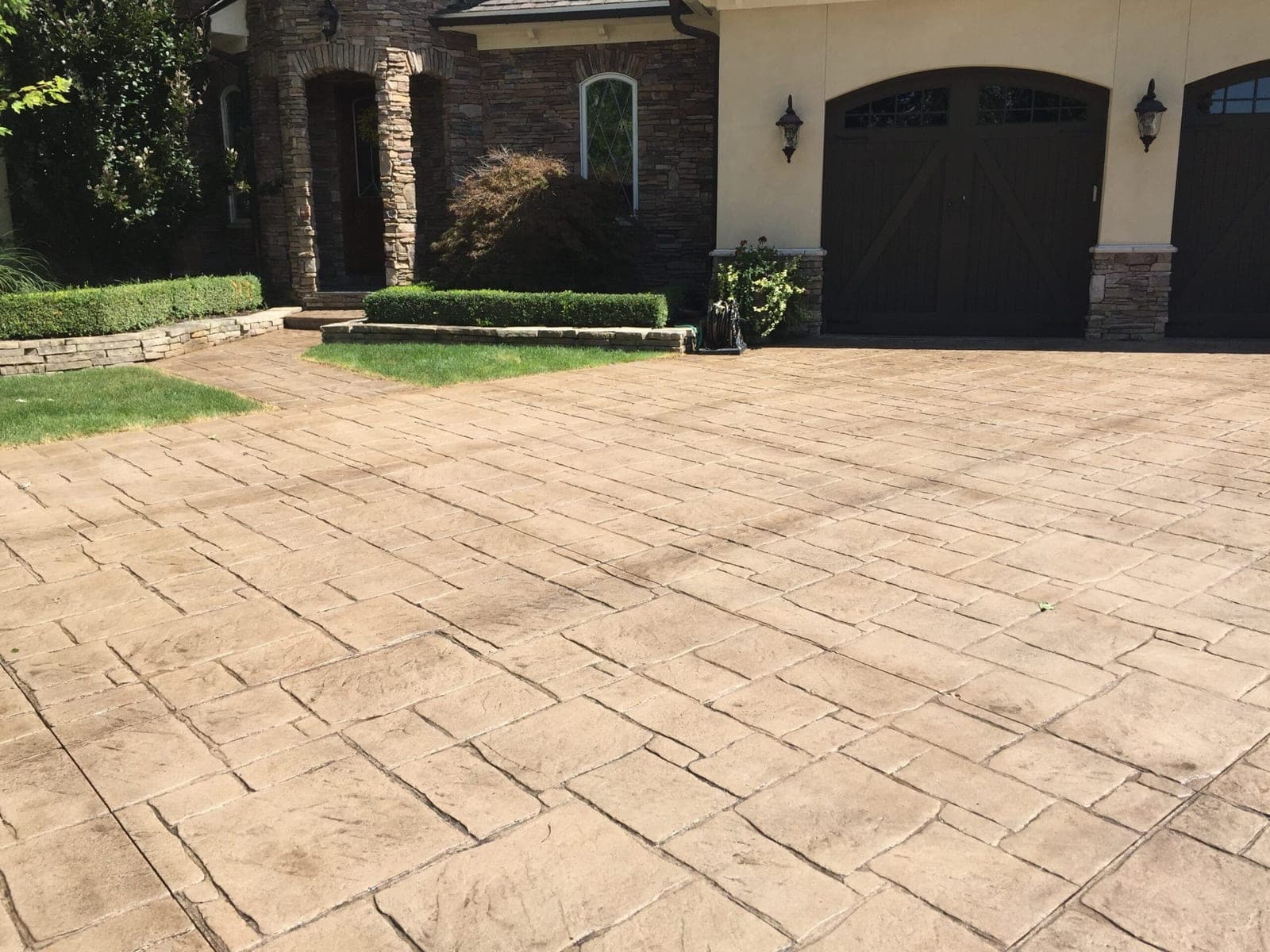
Guides/Planning·7 min read·Updated September 5, 2026
Two to four years is the general guideline, but traffic, exposure and finish all shift the timeline. Here is how to read your own concrete rather than guess.
Key takeaways
- 1Concrete in Southwestern Ontario typically needs resealing every two to four years, depending on traffic volume, sun exposure and how much road salt the surface sees each winter.
- 2Driveways generally wear faster than patios and walkways because of vehicle traffic, tire heat and winter salt, so they often sit at the shorter end of the two-to-four-year range.
- 3Solvent-based acrylic sealer re-emulsifies with the previous coat, so recoating on schedule keeps the surface looking seamless rather than patchy or layered.
- 4Signs a surface is due for resealing include water no longer beading on the concrete, fading colour, a duller sheen, and increased staining from leaves, oil or salt.
- 5Waiting too long between reseals does not just affect appearance; it leaves the concrete more exposed to freeze-thaw damage and salt penetration during Ontario winters.
One of the most common questions homeowners across London, Woodstock, Brantford and the surrounding towns ask is simply how often their driveway or patio actually needs to be resealed. The honest answer is that it depends on the surface, but there is a useful general guideline: most sealed concrete in Southwestern Ontario needs a fresh coat every two to four years. What determines where a specific surface falls in that range, and how to tell when the clock has actually run out, is worth understanding rather than just marking a calendar reminder and hoping for the best.
The two-to-four-year guideline
Two to four years is a reasonable planning window for most residential driveways, patios and walkways sealed with a high-quality solvent-based acrylic sealer. This range exists because no two properties see the same conditions. A driveway used daily by two vehicles, salted heavily every winter, and facing full sun most of the day is going to wear differently than a lightly used walkway on the shaded side of a house. Rather than treating two to four years as a fixed number, it is more useful as a starting point that then gets adjusted based on the specific factors below.
What shortens the timeline
Several factors push a surface toward the two-year end of the range rather than the four-year end. Vehicle traffic is the biggest one; driveways see far more wear than patios or walkways simply because tires are heavy, hot in summer, and constantly moving across the same tracks. Road salt is another major factor specific to this region, since Southwestern Ontario winters mean months of salt exposure on driveways and any walkway that gets treated for ice. Full sun exposure accelerates UV breakdown of the sealer film, which is relevant for south-facing driveways and patios with no tree cover. Commercial surfaces, covered under /services/driveway-sealing and the broader commercial sealing service, often see even heavier and more constant use than residential properties, which can shorten the interval further.
New subdivisions around London and Woodstock present a specific version of this issue. Newer concrete poured in the last few years is often still settling and curing fully, and combined with clay soils common in the region that shift more with freeze-thaw cycles, these driveways can show wear patterns a little differently than older, more settled concrete elsewhere in Southwestern Ontario.
What extends the timeline
On the other end, patios and walkways with lighter foot traffic, more shade, and less winter salt exposure often make it to the four-year mark or occasionally a bit beyond before resealing is really necessary. Finish choice also plays a small role in how gracefully wear shows, with matte and semi-gloss finishes generally masking gradual fading better than a high-gloss finish, as covered in our guide comparing matte, semi-gloss and gloss finishes. None of this means a lightly used surface should be neglected indefinitely; it simply means the interval can reasonably stretch toward the longer end of the range.
How to tell your concrete is due
Rather than relying purely on a calendar, there are visible signs that a surface has reached the point where resealing is worth scheduling. The simplest test is water behaviour: on properly sealed concrete, water beads up on the surface rather than soaking in. When water starts absorbing into the concrete instead of beading, the sealer has worn thin enough that it is no longer doing its job effectively. Fading colour and a duller sheen are also reliable indicators, especially on stamped or coloured concrete where the whole appeal of the surface depends on the colour staying vivid. Increased staining from leaves, oil drips, tire marks or salt residue is another sign, since a fresh sealer coat resists staining far better than a worn one.
Why waiting too long matters more than it looks
A worn sealer coat is primarily a cosmetic issue at first, with fading colour and reduced sheen being the most visible symptoms. But the underlying concern is functional, not just visual. Once a sealer has worn thin enough that water is soaking into the slab rather than beading off, the concrete underneath becomes more vulnerable to exactly the kind of freeze-thaw damage that Southwestern Ontario winters are known for. Water that gets into the pores of the concrete and then freezes expands, and repeated cycles of this can contribute to surface spalling, cracking and general deterioration over time. Road salt exposure compounds this, since salt-laden water penetrating unprotected concrete is more aggressive than plain water alone. Staying on a reasonable reseal schedule is, in this sense, less about keeping the surface looking new and more about protecting the underlying concrete investment from the specific stresses of this climate.
Why solvent-based sealer makes staying on schedule easier
One practical advantage of the high-quality solvent-based acrylic sealer TriCity Concrete Sealing applies is that it re-emulsifies with the previous coat during a recoat, meaning the new application blends seamlessly with what is already there rather than sitting as a visibly separate layer. This matters for staying on a reasonable reseal schedule because it removes one of the common hesitations homeowners have about recoating: the worry that repeated resealing will build up an uneven, patchy-looking surface over time. With proper solvent-based product and correct application, that is not the outcome; the surface should look consistent whether it is on its first coat or its fourth. More on how this works chemically is covered in our guide on solvent-based versus water-based sealers.
How the process fits into your schedule
The application process itself is straightforward and does not require dramatic changes to how you use your property in the lead-up. The surface gets pressure washed and cleaned, allowed to dry fully, and any minor surface issues get repaired before masking and sealer application by sprayer with back-rolling to avoid lap marks. Once applied, the sealer is dry to the touch within one to two hours, safe for foot traffic the next day, and ready for vehicle traffic after 48 to 72 hours. Because application depends on dry surfaces and temperatures roughly between 10 and 30 degrees Celsius, the practical window in this region runs from spring through fall, so scheduling around that window is worth keeping in mind if your concrete is coming due for a reseal heading into winter.
Tracking your own reseal timeline
A practical habit worth building is simply noting the date of each sealing job somewhere you will remember it, whether that is a home maintenance folder, a phone reminder, or a note in a calendar app. Because the two-to-four-year range depends on so many property-specific factors, a written record of when your driveway or patio was last sealed is more useful than trying to estimate from memory a few years later. This is particularly relevant for homeowners who move into a property with concrete that was sealed by a previous owner's contractor, where the sealing history may not be obvious just from looking at the surface. If you are unsure when your concrete was last sealed, or whether it has ever been sealed at all, that is a reasonable question to bring to a free site assessment rather than something you need to figure out beforehand.
Commercial properties and reseal frequency
Commercial surfaces, such as sealed walkways, entryways or loading areas, often face a different wear pattern than residential driveways and patios. Higher foot traffic volume, more frequent vehicle movement in areas like loading zones, and in some cases more aggressive winter maintenance practices such as heavier salting can all push commercial concrete toward more frequent resealing than the typical residential two-to-four-year range. Business owners across London, Woodstock, Brantford and the surrounding service area planning maintenance budgets should factor this in, since a commercial property that sees continuous public traffic is a different maintenance case than a driveway used by one household. TriCity Concrete Sealing's commercial sealing service can assess a specific property's traffic pattern and recommend a realistic interval rather than applying the residential guideline by default.
Getting a straightforward answer for your property
Because so many variables affect the actual interval, from traffic and sun exposure to finish choice and prior sealer history, the most reliable way to know whether your driveway, patio or walkway is due is to have it looked at directly rather than counting years since the last coat. TriCity Concrete Sealing offers a free site assessment across London, Woodstock, Brantford, St. Thomas, Stratford, Ingersoll, Tillsonburg, St. Marys, Aylmer and Simcoe, and with more than 500 projects completed over 8-plus years, the crew can generally tell at a glance whether a surface still has protective life left or is due for a fresh coat. Every reseal, like every original application, is backed by a 5-year workmanship warranty. To find out where your concrete stands, request a quote at /contact
Frequently asked questions
How often does a driveway need to be resealed compared to a patio?
Driveways generally sit at the shorter end of the two-to-four-year guideline because of vehicle traffic, tire heat and heavier winter salt exposure, while patios and walkways with lighter use and more shade often stretch toward the longer end.
What is the clearest sign my concrete needs resealing?
Water no longer beading on the surface is usually the most reliable indicator. Fading colour, a duller sheen, and increased staining from leaves, oil or salt are also common signs the sealer has worn thin.
Does waiting too long between reseals damage the concrete itself?
It can. Once the sealer wears thin enough that water and salt penetrate the slab, the concrete becomes more vulnerable to freeze-thaw damage over Ontario winters, which is a functional concern beyond just appearance.
Will repeated resealing eventually make the surface look uneven or built up?
Not with a properly applied high-quality solvent-based sealer. It re-emulsifies with the previous coat, so recoating blends into one continuous film rather than layering unevenly over time.
What time of year can concrete be resealed in Southwestern Ontario?
Sealing requires dry surfaces and temperatures roughly between 10 and 30 degrees Celsius, which in this region generally means spring through fall rather than winter.
How do I know exactly when my property is due?
The most reliable way is a free site assessment, since traffic, sun exposure, finish and prior sealer history all affect the timeline. Book one through /contact or by
Free quote
Want us to just handle it?
Free site assessment, finish samples in hand, written quote with a 5-year warranty.
Keep reading
Planning · 6 min
The Best Time of Year to Seal Concrete in Ontario
Sealing concrete is a weather-driven job, not a date on the calendar. Here is how the spring-through-fall window actually works and how to plan around it in Southwestern Ontario.
Planning · 7 min
When Can You Seal New Concrete (and Why Waiting Matters)
Sealing new concrete too early can trap moisture and cause problems that show up later. Here is why the curing period matters and how to plan around it.
Finishes · 8 min
Matte vs Semi-Gloss vs Gloss: Choosing a Concrete Sealer Finish
The finish you choose changes how a driveway or patio looks and how it performs underfoot. Here is how matte, semi-gloss and gloss actually compare before you decide.